Over the summer of 2025, Google made several significant changes that have shaken up how marketers and SEO professionals interpret search performance. The first major update was the June 2025 Core Update, rolled out between June 30 and July 17.
This broad algorithm adjustment aimed to surface more relevant and satisfying content across a wide range of sites.
While niche and independent sites that produce high-quality, original content often benefited, many large e-commerce and generic content sites experienced a drop in visibility.
The update also highlighted the rising influence of AI-driven result summaries and zero-click searches, particularly affecting news, health, and finance verticals.
Following this, Google released its August 2025 spam update on August 26, targeting low-quality, thin, or manipulative content globally.
This update reinforced the importance of author transparency, originality, contextual relevance, and clean link profiles. Across June through August, tools like Semrush and SimilarWeb reported notable volatility in SERP visibility, signalling a stronger emphasis on content quality and trustworthiness.
Then came September’s unexpected shake-up. This change triggered sudden, dramatic drops in Google Search Console (GSC) impressions, leaving many site owners puzzled.
Now that we’ve recapped what Google’s been up to over the summer, let’s dive into the September issue and examine how it could impact SEO both in the short term and over the long run.
In mid-September 2025, website owners and SEO professionals noticed a sudden and dramatic drop in Google Search Console (GSC) impressions, particularly on desktop.
The root of this shift appears to be Google’s disablement (or significant restriction) of the &num=100 URL parameter, which had long allowed users and SEO tools to retrieve up to 100 search results in a single page instead of the standard ten.
For years, rank tracking tools and scrapers leveraged this parameter to efficiently capture deep SERP data, often including positions far beyond what typical users would see.
As a result, many impressions previously recorded in GSC were not from actual human views, but from automated bot or scraper activity pulling large numbers of results at once.
With the parameter disabled, the artificial impressions discussed above have largely disappeared, causing the sharp decline observed in GSC reports.
Interestingly, average positions appeared to improve simultaneously, reflecting the fact that lower-ranking URLs (once heavily weighted by bot activity) were no longer counted in calculations.
Meanwhile, clicks and real user engagement remained relatively stable, confirming that actual search visibility for human users was largely unaffected.
The immediate impact was also felt across SEO tools: workflows relying on the &num=100 parameter broke or became more resource-intensive, as tools now needed to paginate through results instead of fetching them in a single request.
In essence, the September 2025 GSC shift reveals the influence of scraper and bot activity on impression data. It underscores a broader trend toward more accurate, human-centric reporting in Google Search Console.
While the change initially confused, it also presents an opportunity for marketers to focus on meaningful metrics (such as clicks, conversions, dwell time, and top-10 rankings) rather than inflated impressions from deep or non-human interactions.
Although GSC impressions dropped sharply in September 2025, it’s important to note that actual human search visibility was largely unaffected.
Users continued to see and click on top-ranking results, meaning that the decline in impressions primarily reflects a change in how Google measures and reports visibility, rather than a drop in real-world performance.
For SEO professionals, this shift underscores the need to reassess how metrics are interpreted:
In practical terms, this change signals a broader trend in SEO strategy. The emphasis is moving away from deep SERP scraping and chasing visibility in low-ranking positions that few users actually reach.
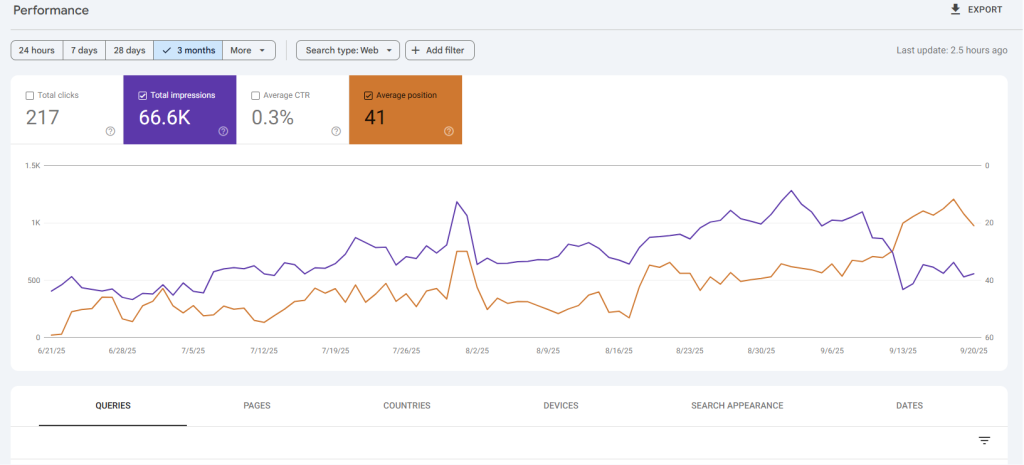
When this shift happened, we looked at the SEO metrics and saw impressions drop sharply while average position improved.
This confirmed that Google’s changes weren’t hurting real visibility but reshaping how performance is reported.
For marketers, this means adapting strategies to focus on meaningful metrics and engagement rather than relying on inflated numbers. Let’s look at how to respond.
Rather than relying solely on impression counts, measure performance through metrics that reflect actual user behaviour.
Click-through rates, time spent on page, and conversion actions provide a more accurate picture of how your content resonates with your audience.
These are less affected by changes like the &num=100 removal and give insights into actual SEO impact.
Google Search Console metrics may now exclude impressions previously inflated by bots or scraper activity. Use Google Analytics, heatmaps, and other analytics platforms to validate trends and ensure that your reporting captures fundamental user interactions.
Multiple data sources help prevent misinterpretation of changes in SERP visibility.
Tools that fetch data from deep SERP positions may now show gaps or inflated costs. Reconfigure rank-tracking settings to focus on top-ranking results or adjust the depth of tracking to maintain accurate insights. Consider the impact of increased API calls or pagination requirements on both workflow efficiency and cost.
While reporting nuances have shifted, the core principles of SEO remain: publish original, authoritative content that aligns with user intent.
Engagement-focused strategies, proper contextual relevance, and clean link profiles will ensure your site maintains visibility and trustworthiness in the evolving search ecosystem.
The September 2025 drop in Google Search Console impressions stands out as one of the most significant and talked-about events in this year’s string of Google updates.
While at first glance it may appear alarming, the reality is that much of the shift reflects changes in how Google counts impressions, rather than an actual loss of visibility for real users.
For marketers and SEO professionals, this serves as a reminder: numbers in isolation can mislead.
Interpreting data carefully, cross-checking multiple sources, and understanding the mechanics behind reporting are essential for accurate performance assessment.
Looking forward, the key is proactivity. Monitor trends closely, analyse performance through meaningful metrics such as clicks, dwell time, and conversions, and optimise strategies based on what truly reflects user engagement.
In a landscape where Google continues to refine its systems and AI-driven features increasingly influence search, staying adaptive and data-informed is essential for long-term SEO success.
Read our blogs for more information on the marketing world! Turn Your Blogs into Social Media Posts in One Click
